


Most "membership" pitches ask you to pay now and trust that the value shows up later. I'd rather just show you the math. If you buy my music, here's the point where a membership costs you less than not having one.
The short version
If you buy even one piece a month, a membership usually pays for itself the first time you check out. The discount is bigger than the dues. That's the whole trick. You're not paying for a perk. You're paying ten or twenty dollars to knock a much larger amount off what you were already going to spend.
Let me show you with real numbers.
Virtuoso: $10 a month
Virtuoso gets you 40% off solo, duet, trio, and quartet music, plus 10% off orchestral and institutional scores.
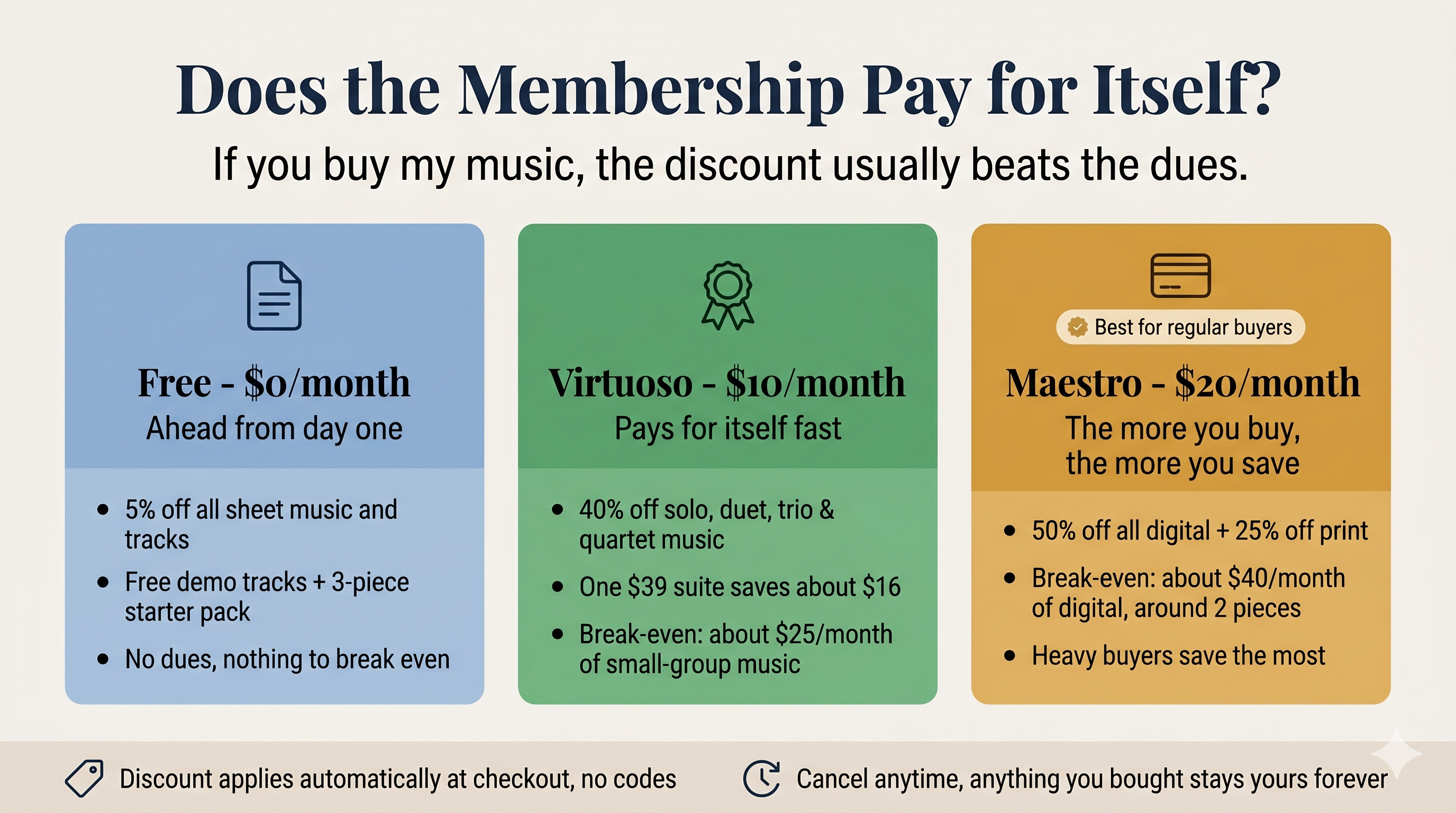
Say you grab one solo suite priced at $39. At 40% off, you save about $15.60 on that one purchase. The membership cost you $10. You're already ahead, and you haven't bought anything else yet.
So the break-even is low. If you spend more than $25 a month on small-group music, the 40% discount alone covers your dues. Anything past that is money back in your pocket. Buy two or three pieces in a busy month and the membership isn't a cost at all. It's a rebate.
Maestro: $20 a month
Maestro gets you 50% off all digital music and 25% off print.
Half off is a steep discount, so the break-even is still easy to hit. You'd need to spend $40 a month on digital music for the discount to match the dues. That's usually two pieces. Buy more than that, which directors and active programs often do, and you're saving real money every month.
A program that's building a library, ordering for a concert cycle, or stocking up for a season tends to clear that bar without trying. At 50% off, the math just keeps tilting in your favor the more you buy.
Free: $0 a month
If you're not buying much yet, start free. You still get 5% off everything, free demo tracks, and a starter pack of three orchestral underscore pieces with full score and parts. It costs nothing, so there's no break-even to hit. You're just slightly ahead from day one.
It's also the smart way to test the idea. Join free, buy a few things at 5% off, and watch your own spending. If you notice you're ordering enough that 40% or 50% off would have saved you more than the dues, that's your signal to upgrade. The numbers tell you when, not me.
How to know which tier fits
Look at what you spent on sheet music last year and divide by twelve. That's your monthly number.
If it's small or uneven, stay free. If you're regularly buying solo and small-group pieces, Virtuoso's 40% almost certainly beats the $10. If you're a director or a program buying digital music in any volume, Maestro's 50% off is hard to lose with.
You don't have to guess. The discount applies the moment you join, automatically at checkout, no codes to enter. So you can do the math on your very next purchase and see it for yourself.
The discount is just the front door
I'll be honest about one thing. The savings are the reason most people join, but they're not the only reason people stay. Depending on your tier, a membership also clears the way to post and monetize your performances, livestream, and license the music for your church or school without asking permission each time. If none of that matters to you, no problem. You came for the savings, and the savings are real. But it's there the day you need it, at no extra cost.
One last thing
Anything you buy is yours forever, member or not. If you ever cancel, the music you purchased doesn't go anywhere. You just lose the discount going forward. So there's no trap here and nothing to lose by testing it.
Start free. Buy your next piece at a discount. If the savings beat the dues, upgrade. If they don't, you're still ahead. JOIN NOW.